Georgia has been inhabited since ancient times. According to Georgian tradition, the script was created in the 3rd century BC under King Parnavaz. The oldest surviving Georgian inscriptions date from the 5th century AD. The Georgian alphabet is one of the few original alphabets in the world.
In the 6th century BC the kingdom of Colchis (Egrisi) emerged in what is now western Georgia. In the 4th century BC the kingdom of Iberia (Kartli) was formed in eastern Georgia.
Later, four principalities existed in western Georgia: those of the Lazi, Apsilae, Abasgoi and Sanigae. The Lazi principality was the strongest. It brought the other three under its rule and created the state of Lazica.
The reign of Queen Tamar, at the end of the 12th and beginning of the 13th century, is regarded as Georgia's golden age.
Over the centuries Georgia fought many invaders: Arabs, Byzantines, Mongols, Persians, Ottomans and North Caucasian tribes. There were also internal struggles among the Georgian princes.
In the 13th century the Mongols conquered Georgia. In the 14th century King George V the Brilliant reunited the country. By the end of that century Timur (Tamerlane) had invaded Georgia eight times and devastated it. In 1490 Georgia formally split into the kingdoms of Kartli, Kakheti and Imereti and the principality of Samtskhe.
In the 16th century the principalities of Mingrelia (Samegrelo), Guria, Abkhazia and Svaneti broke away from Imereti. Under the Peace of Amasya in 1555, Iran and the Ottoman Empire divided Georgia between them: Kartli and Kakheti fell under Iranian influence, western Georgia and Samtskhe under Ottoman influence.
In 1633 Rostom Khan became king of Kartli. In 1762 King Erekle II united Kartli and Kakheti. Under the Treaty of Georgievsk of 1783, the Kingdom of Kartli-Kakheti became a Russian protectorate.
In 1801 Russia abolished the Kingdom of Kartli-Kakheti and annexed it as a province. Over the following decades Russia gradually annexed the remaining Georgian lands. On 26 May 1918, after the collapse of the Russian Empire, Georgia declared independence as the Democratic Republic of Georgia.
In February 1921 the Red Army invaded Georgia and the country became part of the Soviet Union. Within the Georgian SSR, the Adjarian Autonomous Republic (1921), the South Ossetian Autonomous Oblast (1922) and the Abkhazian Autonomous Republic (autonomous within Georgia from 1931) were created.
On 9 April 1991 Georgia restored its independence. In May 1991 Zviad Gamsakhurdia was elected the first president. In December 1991 and January 1992 an armed coup in Tbilisi overthrew the legitimate government and President Gamsakhurdia.
In 1992 Eduard Shevardnadze became head of the State Council. In August of that year war broke out in Abkhazia. Mercenaries fought on the side of the Abkhaz forces, and Russian units stationed in Abkhazia also supported the Abkhaz side. The war ended in September 1993 with the defeat of the Georgian forces.
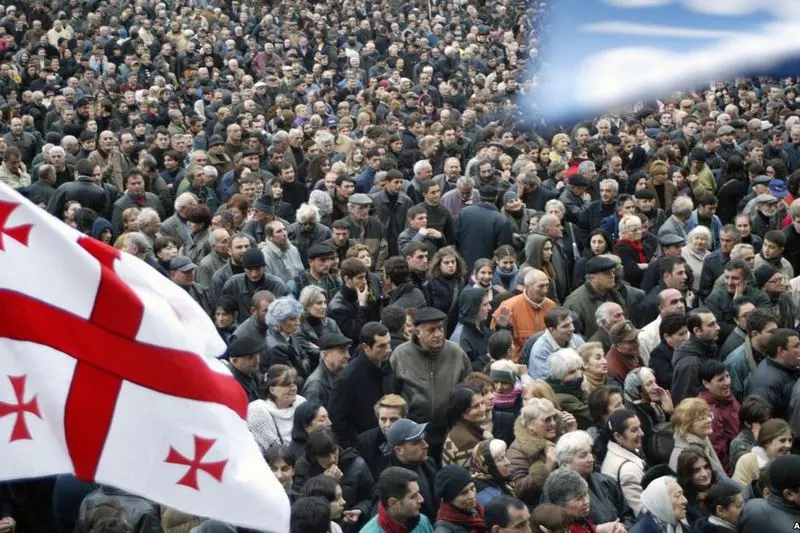
Shevardnadze was elected president in 1995 and re-elected in 2000. After disputed parliamentary elections in November 2003, mass protests began. On 23 November 2003 Shevardnadze met opposition leaders, with Russian Foreign Minister Igor Ivanov acting as mediator, and resigned after the meeting. Parliament Speaker Nino Burjanadze became acting head of state. These events are known as the Rose Revolution.
In the extraordinary presidential election of 4 January 2004, Mikheil Saakashvili won more than 96% of the vote. Zurab Zhvania became prime minister.
In May 2004 the leader of Adjara, Aslan Abashidze, left the country, and the autonomous republic returned to the control of the central government. A series of reforms followed.
In August 2008 war broke out between Georgia and Russia over South Ossetia. Russia recognised the independence of Abkhazia and South Ossetia. Apart from Russia, only Nicaragua, Venezuela, Nauru and Syria have recognised them. Georgia regards both regions as occupied territories, and most states support Georgia's territorial integrity. Russian troops remain in both regions today. After the war Georgia broke off diplomatic relations with Russia and left the Commonwealth of Independent States, with effect from 18 August 2009.
In the parliamentary elections of 1 October 2012, power in Georgia changed hands peacefully through elections for the first time since independence.